
top of page

Top Oil Free Compressor Manufacturers for Global Buyers

Choosing the right oil free compressor is a practical decision for global buyers. It affects air quality, production stability, energy use, and maintenance costs. A compressor may look efficient on paper. Real factory conditions can tell a different story.

This guide examines leading manufacturers serving international markets. It considers compressor design, air purity, operating pressure, noise, cooling systems, and lifecycle support. Buyers can compare scroll, screw, piston, and centrifugal technologies. Each option fits different production demands. Food packaging may require clean, dry air. Electronics plants may need stable pressure around the clock. Medical facilities often require dependable backup planning.

Certification matters. So does evidence. Reliable manufacturers should provide test data, service records, warranty terms, and clear information about ISO 8573-1 air quality classes. Local technicians, spare-part access, and response times deserve equal attention. A low purchase price may become expensive after repeated service delays.

No supplier is perfect. Published energy figures may use controlled test conditions. Actual performance can change with heat, altitude, load patterns, and poor installation. Buyers should request site-specific calculations and independent verification where possible. This article offers a balanced starting point, not a final purchasing decision. It highlights manufacturers with strong market experience, technical capability, and international support. Still, every shortlist needs careful checking. The best choice should match the application, budget, compliance needs, and long-term operating reality.
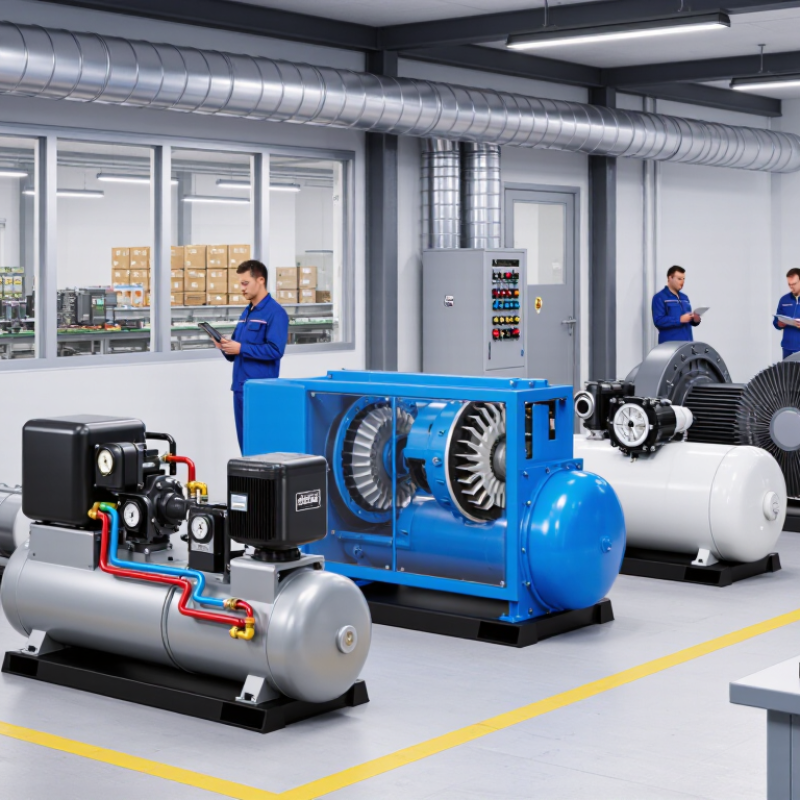
Top Oil Free Compressor Manufacturers for Global Buyers

Oil-Free Compressors: Definition, Types, and Core Applications

Oil-free compressors deliver compressed air without oil entering the compression chamber. This design protects sensitive processes from lubricant contamination. It differs from oil-injected equipment, which separates oil after compression.

Common types include scroll, screw, piston, and centrifugal compressors. Each uses a different compression method and cooling arrangement.

Scroll units suit quiet, low-flow operations. Screw compressors support continuous industrial demand. Piston models handle intermittent workloads. Centrifugal systems serve large facilities with stable air consumption.

Core applications include medical air, food packaging, electronics assembly, laboratories, and textile production. In these areas, even a small oil trace can damage products or complicate compliance. Buyers should review air purity under ISO 8573-1, not only the phrase “oil-free.” They should also check flow stability, dew point, noise, and service access. A compressor may produce clean air but still need filters for water and particles. That detail is often overlooked.

Tips: Match compressor capacity to real demand, including leaks and peak shifts. Oversizing wastes energy. Undersizing creates heat and pressure drops. Ask for test data, maintenance intervals, and operating costs. Cooling conditions matter, especially in dusty or hot rooms. In practical plant reviews, the quietest machine is not always the most efficient. The best choice depends on duty cycle, air quality, and technician skill. Some assumptions will be wrong. Recheck them with measured demand.

Key Criteria for Evaluating Global Oil-Free Compressor Manufacturers

Global buyers should evaluate oil-free compressor manufacturers beyond catalogue pressure and advertised efficiency. The U.S. Department of Energy reports that compressed-air leaks can waste 20–30% of compressor output in poorly maintained systems. Therefore, request measured specific power, flow, noise, and pressure data under comparable ISO 1217 test conditions. A polished brochure is not enough.

Air purity requires equal attention. ISO 8573-1 classifies particles, water, and oil, but certification should match the application. Food processing, electronics, and pharmaceutical plants may require stricter contamination controls. Ask for independent laboratory reports, factory acceptance testing, and traceable calibration records. Check whether the manufacturer can maintain stable air quality during load changes, high humidity, and frequent starts. Small details matter.

Lifecycle evidence often separates a capable supplier from a convenient one. Review service response times, spare-parts availability, technician training, and remote monitoring practices across your operating region. The International Energy Agency identifies motor-driven systems as responsible for a major share of industrial electricity use, making energy performance commercially important. Yet efficiency claims can become misleading when inlet filters clog or dryers add pressure loss. Insist on annual energy simulations using your actual duty cycle. I would also question unusually perfect projections. Real plants are messier. A two-year field record may reveal more than a confident sales estimate.

Leading Oil-Free Compressor Manufacturers by Market and Region

Top Oil Free Compressor Manufacturers for Global Buyers

Leading Oil-Free Compressor Manufacturers by Market and Region

Oil-free compressor manufacturers serve different industrial priorities across global markets. European suppliers often emphasize energy efficiency, low noise, and documented air purity. Their systems commonly support pharmaceutical, food processing, and electronics production. North American manufacturers usually focus on service access, modular design, and compatibility with existing plant controls. Buyers should verify ISO 8573-1 air-quality data, not rely on marketing language.

Asia-Pacific has a broad manufacturing base, with suppliers offering competitive pricing and fast production capacity. Quality can vary between product lines, so factory audits and reference checks remain important. Some manufacturers provide strong engineering support, while others mainly compete on initial cost. That difference matters after installation.

Middle Eastern and African buyers may prioritize dust protection, cooling performance, and regional spare-parts availability. Latin American facilities often need flexible voltage options and practical maintenance training. A reliable manufacturer should explain pressure loss, expected service intervals, and lifecycle energy use clearly.

Ask for test records. No regional ranking is perfect. Local climate, operator skill, and compressor loading can change the best choice.

Even experienced buyers sometimes underestimate installation conditions, especially ventilation and air-treatment requirements.

Technology, Certifications, Energy Efficiency, and Product Reliability

Top Oil Free Compressor Manufacturers for Global Buyers

Technology matters when compressed air touches medicine, electronics, food, or clean manufacturing. Oil-free designs remove lubricant from the compression chamber, reducing contamination risks. Buyers should check ISO 8573-1 Class 0 documentation, not accept vague “oil-free” wording. Class 0 is the strictest oil-contamination category. It still requires controlled testing and maintenance.

Energy efficiency deserves equal attention. The U.S. Department of Energy reports that compressed air can represent 10% to 15% of industrial electricity use. Its compressed-air guidance also identifies leakage as a major waste source, often reaching 20% to 30% of compressor output in poorly managed systems. Variable-speed control, low-pressure-drop filters, and heat recovery can reduce operating costs. However, savings depend on demand patterns. A factory running one shift should not purchase equipment sized for three shifts.

Certifications show discipline, but they do not guarantee reliability. Look for ISO 9001 quality systems, ISO 14001 environmental practices, and ISO 50001 energy management where relevant. The International Energy Agency’s Energy Efficiency 2023 report highlights the continuing importance of efficient motors and industrial system controls. Ask manufacturers for verified specific power, noise data, service intervals, and performance results at partial load. Field experience matters. A compressor may meet its laboratory rating yet perform poorly in a dusty room with unstable voltage. That assumption fails. Buyers should request local spare-parts access, technician training, and a written response-time commitment. Availability is part of efficiency.

How Global Buyers Can Compare Suppliers and Select the Right Model

For global buyers, choosing an oil-free compressor starts with the application, not the catalog. Review air purity requirements, flow demand, pressure range, duty cycle, and installation conditions. A medical line may need cleaner air than a workshop tool. Confirm whether the supplier provides testing data under recognized standards, not only marketing claims. Ask for oil carryover results, noise readings, and performance at your actual voltage and ambient temperature. Experienced suppliers should explain testing methods clearly. If answers remain vague, treat that as useful evidence.

Compare at least three suppliers using the same technical requirements. Check whether the compressor suits continuous operation or only intermittent use. Scroll, screw, and piston designs can perform differently under changing loads. Calculate energy use, filter replacement, maintenance, spare-part access, and expected service life. The cheapest quotation may create higher costs later. Request installation references from similar industries and climates. I have seen specifications look excellent on paper, while hot rooms reduced real output.

Tips: Build a simple comparison sheet. Record flow, pressure, power, noise, cooling, warranty, spare-parts availability, and response time. Request a reference installation in a similar environment. Test the compressor near peak demand, not only at idle. Leave room for uncertainty. Your site may be warmer, dustier, or less stable than the supplier’s test room, and that difference can change the right model.

Top Oil Free Compressor Manufacturers for Global Buyers - How Global Buyers Can Compare Suppliers and Select the Right Model

Supplier-neutral comparison guide for selecting an oil-free compressor technology and evaluating international suppliers.

Compressor Technology Typical Outlet Pressure Typical Capacity Range Best-Fit Applications Air Purity Position Main Advantages Key Limitations Supplier Selection Checks
Oil-Free Scroll Approximately 1.5–10 bar(g) Approximately 0.1–3 m³/min per package Dental facilities, laboratories, small medical systems, electronics and light industrial equipment Class 0 available
Confirm certification for the complete package and outlet conditions.
Low vibration, low noise, compact footprint and simple modular expansion Lower capacity per unit; scroll tips and valves require scheduled inspection; not ideal for large continuous-duty plants Check noise level, duty cycle, redundancy arrangement, dew point and availability of replacement scroll components
Dry Oil-Free Screw Approximately 5–13 bar(g) for common industrial configurations Approximately 1–100 m³/min, depending on frame size and pressure Food and beverage, pharmaceuticals, textiles, automotive, general manufacturing and process air Class 0 available
The compression chamber is designed without oil; verify downstream contamination controls.
Suitable for continuous operation, broad capacity range and good plant-level scalability Higher capital cost than lubricated screw compressors; rotor coatings, coolers and air seals need appropriate maintenance Request ISO 8573-1 test evidence, full-load and part-load power data, service intervals and coating warranty terms
Water-Injected Screw Approximately 5–13 bar(g) Approximately 1–30 m³/min, depending on the configuration Industrial plants requiring oil-free compression with moderate pressure and stable continuous demand Application-dependent
The compression chamber uses water; confirm water quality, filtration and outlet-air requirements.
Water provides cooling and sealing; may achieve a compact single-stage design at moderate pressure Requires water-treatment control, water separation and freeze or corrosion protection; not equivalent to a dry screw design in every installation Evaluate water consumption, water-treatment specification, drain design, ambient-temperature limits and service support
Oil-Free Reciprocating Approximately 7–30 bar(g), with higher pressure available in multi-stage designs Approximately 0.05–5 m³/min High-pressure laboratory air, PET preforms, gas boosting, instrumentation and small intermittent systems Class 0 available
Verify piston-ring material, filtration and package-level test results.
Efficient at smaller flows, capable of relatively high pressure and suitable for intermittent demand More pulsation and vibration than rotary machines; noise and wear can increase with frequent cycling Check receiver sizing, pulsation control, piston-ring life, maintenance kits and maximum starts per hour
Oil-Free Centrifugal Approximately 2–10 bar(g) for common multi-stage plant-air systems Approximately 20–1,000+ m³/min Large continuous-demand plants, steel, chemicals, automotive, utilities and large process-air networks Class 0 available
Confirm the complete air-treatment train and operating envelope.
High flow, low mechanical contact in the compression path and strong suitability for continuous base-load operation Performance is sensitive to flow and inlet conditions; surge control, installation quality and specialist service are important Compare turndown range, surge protection, inlet-filter pressure loss, minimum stable flow and commissioning support
Global Supplier and Model Evaluation Criteria
Air Purity Documentation Required evidence Request a current ISO 8573-1 Class 0 certificate or independent test report that identifies the tested model, operating conditions, sampling method and test laboratory. Do not rely only on the phrase “oil-free.”
Energy Performance Compare like for like Compare specific power in kW per m³/min at the same pressure, inlet condition, cooling method and measurement boundary. Ask for full-load, part-load and unloaded-power data rather than motor rating alone.
Operating Environment Installation suitability Confirm allowable ambient temperature, altitude correction, humidity, cooling-water conditions, enclosure rating, ventilation requirements and cold-start limitations for the destination country.
Lifecycle Support Long-term availability Evaluate local technicians, spare-parts lead time, preventive-maintenance intervals, remote diagnostics, warranty coverage, training and the total cost of ownership over the planned service life.
Commercial Comparison Total delivered cost Compare equipment price, freight, import duties, commissioning, air treatment, receiver capacity, installation, validation testing, consumables, service contracts and expected energy cost.
Model Selection Rule Recommended approach Select the compressor based on measured flow demand, required pressure, air-quality class, duty profile and site conditions. Use a properly sized receiver and consider N+1 redundancy where compressed air is critical to production or safety.
Data note: Pressure and capacity figures are representative ranges for common market configurations, not guaranteed ratings for every model. Actual performance varies with compressor design, motor speed, inlet conditions, cooling method, altitude and control strategy. Buyers should validate final specifications against the supplier’s certified datasheet and independent test documentation.

Article Source:

bottom of page