What Are the Top 10 Types of Mining Trucks?
Mining Trucks are not a single machine category. They range from articulated haulers on uneven, muddy routes to ultra-class rigid trucks carrying hundreds of tons across open-pit mines. The right choice affects haulage capacity, fuel use, tire wear, operator safety, and the mine’s daily production. Size matters. So does the road.
The scale is clear in Caterpillar’s 797F specifications: its rated payload is 400 short tons, with a 2,000-horsepower engine. That is one end of a much broader equipment spectrum, not a universal benchmark. Caterpillar’s published specifications are useful for comparing capacity, but real-world performance also depends on gradient, haul distance, loading equipment, and maintenance conditions. The International Energy Agency’s Global Critical Minerals Outlook 2024 also documents rising pressure on mineral supply chains, making efficient material movement an important operational concern.
Mining engineer and University of Queensland professor Peter Knights has studied mining productivity and technology. A useful paraphrase of that systems-focused perspective is: “Haulage performance depends on how the truck works with the whole mine, not on truck size alone.” Treat that as a guiding principle, not a verbatim quotation.
This guide introduces ten common mining truck types, from articulated dump trucks to large rigid-frame haul trucks. It compares their typical roles, strengths, and practical trade-offs. Some categories overlap. That is worth remembering: mine conditions, rather than a label, determine whether a truck is the right fit.
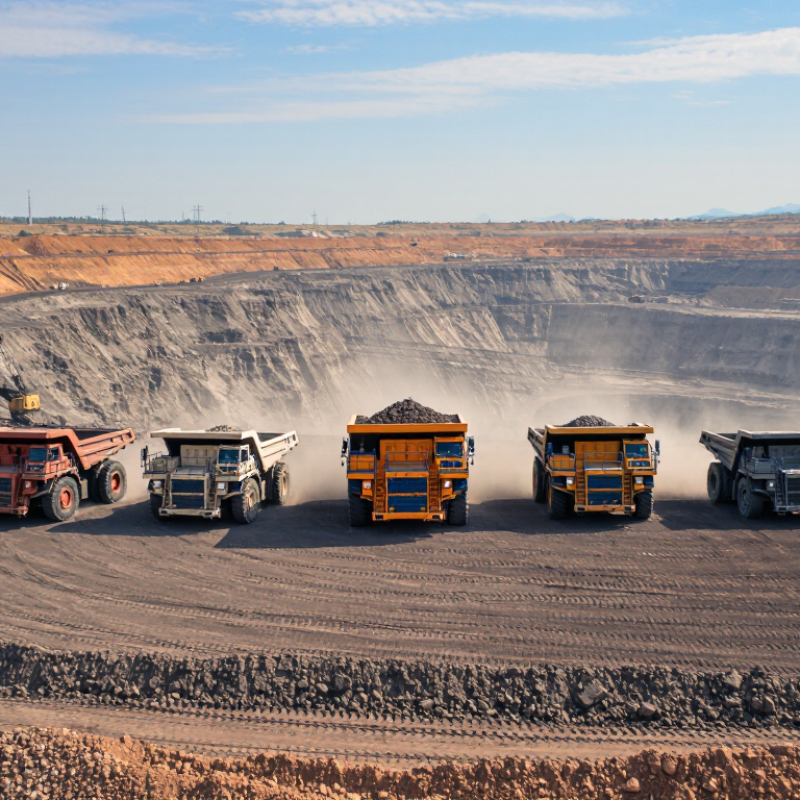
Classify Mining Trucks by Payload, Chassis, Powertrain, and Mine Environment
Mining trucks are best classified across several axes, not by size alone. Payload separates light-duty rigid trucks, mid-range rigid trucks, and ultra-class rigid trucks. Each suits a different haul distance, road condition, and loading rate. Articulated trucks use a jointed frame to handle uneven, soft ground. Their maneuverability can help on short, rough routes.
Mine environment creates another useful distinction. Underground low-profile trucks fit restricted clearances, while underground haul trucks carry ore through confined headings. These designs trade bed capacity for access and turning room. Check tunnel width, gradients, ventilation, and loading equipment before comparing rated payloads. A truck that looks efficient on paper may struggle on a wet ramp. That matters.
Powertrain adds four common types: diesel-mechanical, diesel-electric, trolley-assist, and battery-electric trucks. Mechanical systems send engine power through a transmission; diesel-electric designs use electrical drive components. Trolley-assist draws power from overhead lines on equipped ramps, while battery-electric models avoid tailpipe emissions during operation. These categories can overlap with payload and chassis classes. One detail is easy to overlook: route length and charging or infrastructure access can change the practical choice. I would not treat one specification as decisive; actual cycle data deserves a closer look.
Surface Haulage: Rigid-Frame, Articulated, Electric-Drive, and Water Trucks
Surface haulage relies on trucks matched to road conditions, payloads, and duty cycles. Rigid-frame trucks carry heavy loads efficiently on established mine roads. Their fixed chassis suits wide haul routes with firm surfaces and broad turning areas. That matters. Poor road maintenance, however, can increase vibration, tire wear, and loading delays.
Articulated trucks pivot between cab and body, helping them negotiate tighter turns and uneven ground. They may suit changing work areas, though their flexibility does not remove the need for careful road planning. Electric-drive trucks use electrical systems to transmit power to the wheels. On long, steep routes, this design can support controlled traction and efficient braking. Results depend on truck size, operating conditions, and maintenance. Water trucks serve a different but essential role: spray bars damp dusty roads, while careful application limits excess runoff. Too much water can make surfaces slippery.
Choosing among these types means studying the whole haul cycle, not just rated capacity. Measure gradients, road width, turning space, and loading time. Operators should also inspect spray coverage and braking behavior under real conditions. Small details count. The trade-offs are easy to underestimate, and a truck that suits one route may perform poorly on another. Practical evaluation should include changing weather, road repairs, and the skill level of the operating team.
Underground Haulage: Low-Profile, Narrow-Vein, Battery-Electric, and Dump Trucks
What Are the Top 10 Types of Mining Trucks?
Underground haulage depends on matching a truck to the mine’s geometry, not just its rated payload. Low-profile trucks are built for low roof clearance, where a tall cab or raised dump body can become a serious constraint. Their compact proportions help them pass beneath services and rock supports. Clearance is unforgiving. Operators still need to check turning space, ramp grade, and loading-bay dimensions.
Narrow-vein trucks serve tighter workings, where the ore zone and access drifts leave little room to maneuver. A slimmer body and short turning radius can reduce scraping against walls, but smaller dimensions may limit each load. That trade-off affects trip frequency and traffic planning. A specification sheet alone can mislead; actual drift measurements and ground conditions matter.
Battery-electric trucks can reduce tailpipe exhaust and heat at the point of use, which may ease ventilation demands. They still require charging plans, suitable electrical infrastructure, and attention to battery temperature. Underground dump trucks, meanwhile, move broken rock between loading areas and ore passes or other discharge points. Their articulated steering helps on bends, while braking performance and tire condition deserve close inspection on steep ramps. Details vary by mine. A poor match can slow the whole haul cycle.
Special-Purpose Haulage: Coal and Autonomous Mining Trucks
Coal haulage trucks are built around a different constraint: moving bulky material efficiently across long, dusty routes. Their bodies may prioritize volume, while reinforced liners help withstand abrasive loads and repeated impacts. IEA’s Coal 2024 report puts global coal production at about 8.7 billion tonnes in 2023. That scale makes truck availability, road condition, and loading coordination consequential. Small delays add up. Operators still need to match payload to route gradients and surface conditions; a larger body is not automatically a better choice.
Autonomous haul trucks use sensors, positioning systems, and fleet software to follow mapped routes and respond to operating zones. The Global Mining Guidelines Group’s guidance on autonomous systems emphasizes planning, risk assessment, and clear human oversight—not simply installing technology. In practice, dust, rain, poor road edges, or changing work areas can challenge sensing and dispatch. Autonomy can support consistent cycles, but it cannot repair a badly graded road. That part is easy to underestimate. Mines also need trained staff who can monitor exceptions and safely manage maintenance. A useful evaluation tracks real site measures, such as loaded travel time, idle periods, and unplanned stops, rather than relying on impressive demonstrations.
What Are the Top 10 Types of Mining Trucks?
Special-purpose haulage: coal and autonomous mining trucks
The bars show illustrative typical payload capacity ranges in metric tonnes. Capacities vary by model and configuration; coal-haulage trucks use the same broad capacity classes as other surface mining trucks, while autonomous haulage describes an operating system rather than a separate truck size.
Payload Benchmarks: Cat 745 at 37 t and Cat 797F at 363 t
Payload benchmarks reveal how different mining trucks can be. A 37-tonne articulated truck suits shorter routes, uneven ground, and tighter working areas. Its smaller frame can maneuver around loading zones where a much larger vehicle would struggle. That matters. Payload is only one part of the job: road conditions, gradients, and loading equipment affect each hauling cycle.
At the other end, a 363-tonne rigid haul truck represents an ultra-class machine built for high-volume mine roads. Its capacity can move far more material per trip, but it needs wide routes, carefully managed loading, and substantial space to turn.
Numbers need context. These figures are rated payload benchmarks, not guarantees of daily production. Actual output depends on travel distance, waiting time, surface quality, and how consistently loads are filled.
Comparing the two directly is useful for scale, but not for choosing a truck without considering the site. Payload alone is an imperfect yardstick, and it is easy to overvalue the biggest number.