
10 Best Cigarette Display Racks for Global Retailers
Global retailers need more than a metal frame or illuminated cabinet. They need a Cigarette Display Rack that supports controlled access, clear pricing, efficient replenishment, and responsible customer communication. The fixture must fit different store formats, from compact convenience counters to large supermarket service areas. It should also withstand daily handling, cleaning chemicals, humidity, and repeated stock movement.
The World Health Organization’s WHO Global Report on Trends in Prevalence of Tobacco Use 2000–2030 estimates that about 1.25 billion adults used tobacco in 2022. This figure shows the scale of the retail environment, while also highlighting the importance of strict age-verification procedures and local compliance. Euromonitor International’s Tobacco industry research continues to track changing retail channels, packaging trends, and consumer purchasing behavior across major markets. These shifts make modular display planning increasingly practical.
Retail design expert Paco Underhill wrote, “The easiest way to get people to buy something is to put it in their path,” in Why We Buy. His observation applies to visibility, but responsible retailers must interpret it carefully. A compliant Cigarette Display Rack should organize products without encouraging youth appeal or impulsive access.
Small details matter. Lockable doors, rounded edges, adjustable shelves, and concealed stock areas improve everyday control. Still, no rack solves poor staff training. That is the uncomfortable part. A beautiful fixture can fail when procedures are ignored. This guide examines ten rack solutions for global retailers, comparing durability, maintenance, flexibility, security, and store-level practicality. Not every model will suit every market. That limitation deserves attention.
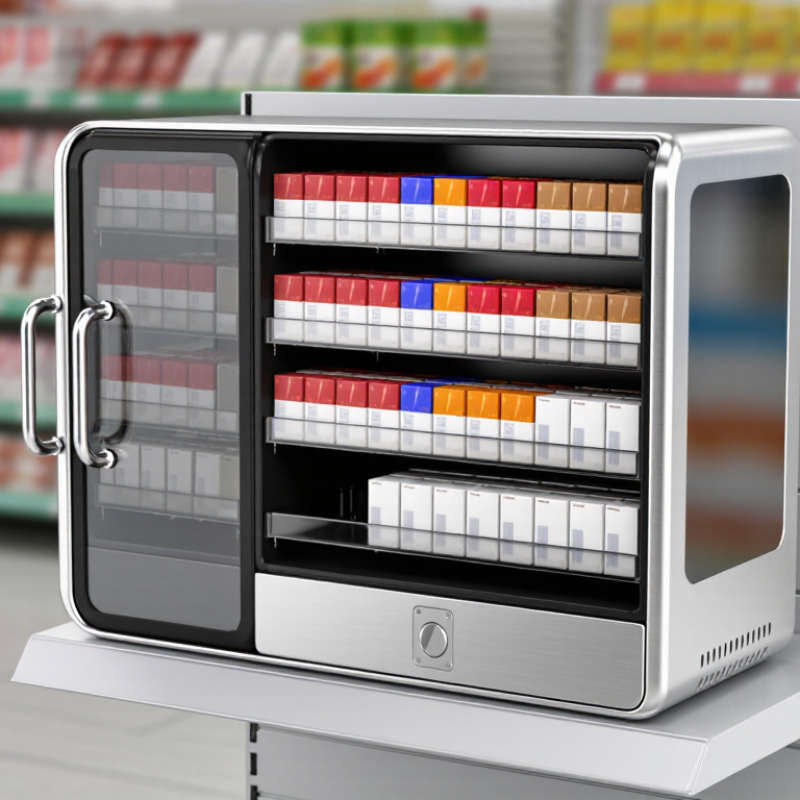
Cigarette Display Racks: Purpose, Structure, and Retail Applications
Cigarette display racks support organized, compliant retail operations. Their purpose is simple: keep regulated products secure, visible to authorized staff, and easy to count. In daily store use, a rack reduces loose cartons behind the counter. It also helps staff notice missing stock quickly. A neat rack is not always a good rack.
Most racks use powder-coated steel, clear panels, adjustable dividers, and lockable doors. Steel provides stability during busy service periods. Clear sections help staff identify pack sizes without unnecessary handling. Dividers should move smoothly but remain firm after adjustment. Rounded edges reduce snagging near checkout areas. Ventilation may matter in enclosed units, especially where heat builds near lighting or equipment.
Retail applications differ by store format and local rules. A compact counter unit can suit a small licensed shop. A larger wall cabinet may support higher stock volumes while limiting customer access. Some markets require concealed presentation, warning notices, or specific placement distances. Retailers should confirm current requirements with qualified local authorities before installation. Staff training is equally important, covering age checks, stock rotation, cleaning, and key control. In my experience, poor labeling creates more delays than limited shelf space. It is worth measuring the counter twice, because real checkout areas rarely match the original plan.
10 Best Cigarette Display Racks for Global Retailers - Cigarette Display Racks: Purpose, Structure, and Retail Applications
| No. | Rack Type | Typical Construction | Typical Dimensions | Approx. Capacity | Best Retail Application | Key Structural Features | Security Level | Main Advantage |
|---|---|---|---|---|---|---|---|---|
| 1 | Lockable Countertop Rack Compact format | Powder-coated steel frame with acrylic or polycarbonate front panel | Approximately 600 W × 220 D × 450 H mm | About 24–40 standard packs | Small convenience stores, checkout counters, and service desks | Multiple horizontal shelves, lockable door, non-slip base | High | Uses limited counter space while keeping products behind the sales staff |
| 2 | Wall-Mounted Slatwall Rack Space-saving format | Steel or aluminum brackets with slatwall-compatible back panel | Approximately 900 W × 180 D × 600 H mm | About 40–72 standard packs | Back-wall merchandising areas and tobacco-service zones | Adjustable shelf spacing, concealed brackets, removable price strips | Medium to high | Maximizes vertical wall space without occupying floor area |
| 3 | Freestanding Floor Cabinet High-capacity format | Powder-coated steel cabinet with reinforced base and lockable front | Approximately 900 W × 450 D × 1,800 H mm | About 120–240 standard packs | Supermarkets, larger convenience stores, and duty-free retail areas | Four to six adjustable shelves, leveling feet, anti-tip provision | High | Provides substantial storage and organized product access in one unit |
| 4 | Rotating Carousel Rack High-access format | Powder-coated steel center column with wire or sheet-metal pockets | Approximately 500 W × 500 D × 1,600 H mm | About 60–120 standard packs | Retail counters with several product categories and limited frontage | 360-degree rotation, divided compartments, weighted circular base | Medium | Allows staff to access multiple product rows from a compact footprint |
| 5 | Modular Drawer Cabinet Organized storage | Steel cabinet body with powder-coated drawers and internal dividers | Approximately 800 W × 400 D × 900 H mm | About 80–160 standard packs | Behind-counter retail environments with frequent stock replenishment | Pull-out drawers, labeled compartments, central locking system | High | Improves stock organization and reduces visible clutter at the counter |
| 6 | Glass-Front Display Cabinet Premium presentation | Steel or aluminum frame with tempered glass door and interior shelves | Approximately 800 W × 350 D × 1,200 H mm | About 60–120 standard packs | Modern convenience stores, specialty tobacco areas, and hotel retail counters | Clear front visibility, adjustable shelves, lockable hinged or sliding door | High | Combines product visibility with controlled staff-only access |
| 7 | Under-Counter Sliding Rack Hidden storage format | Folded steel tray system with ball-bearing slides and mounting rails | Approximately 700 W × 350 D × 300 H mm | About 30–60 standard packs | Small-format stores where counter and wall space are restricted | Full-extension runners, divided trays, front pull handle, concealed installation | High | Uses unused space beneath the counter while keeping products secure |
| 8 | Pegboard Hook Display Rack Flexible format | Perforated steel panel with adjustable hooks and product retainers | Approximately 600 W × 180 D × 900 H mm | About 30–60 standard packs | Temporary layouts, compact stores, and frequently changing planograms | Tool-free hook adjustment, modular accessories, optional lockable cover | Low to medium | Offers flexible product positioning and simple layout changes |
| 9 | Multi-Tier Counter Display High-visibility format | Powder-coated wire or sheet-metal frame with stepped shelves | Approximately 700 W × 250 D × 500 H mm | About 36–72 standard packs | Service counters, kiosks, petrol stations, and compact checkout areas | Two to four stepped tiers, front retaining lips, integrated label holders | Medium | Creates clear product separation and makes stock levels easy to check |
| 10 | Mobile Lockable Merchandising Cart Flexible floor format | Steel cabinet or frame mounted on four industrial swivel casters | Approximately 800 W × 500 D × 1,400 H mm | About 80–160 standard packs | Large retail floors, temporary sales zones, and stores requiring layout flexibility | Lockable storage, two braked casters, adjustable shelves, push handle | High | Can be repositioned for cleaning, seasonal layouts, or security control |
Note: Dimensions and capacities are typical planning ranges for retail fixtures. Actual capacity varies according to pack size, shelf spacing, locking hardware, local regulations, and the retailer’s merchandising plan.